

Section Styles spotlight-header
I am a
Game developer
Bayan Mashat
Presented by SOCIETY FOR SCIENCE

game design requires imagination and collboration.
As a game designer, I use programming and storytelling to create meaningful new games.

MY WORK SETTING


Indoor vs. Outdoor
I spend half of my time working inside on game development and the other half outdoors at the dance studio.


People vs. Alone
I spend some of my time collaborating with other people and a lot of time alone too.


Creative vs. Defined
Most of my work is creative, while some coding techniques are structured.

-
I’m the founder of my own game design studio, “Blue Tango Street”. I get to use my imagination to help others have meaningful experiences through games. This work requires a lot of different skills, some social, some technical, and some creative. Some days I'm imagining my next game, other days I'm bringing a game to life with collaborators, and others I am working on the business and operational side of the studio. No two days are the same.
-
I start with a game’s concept and test ways to turn it into a playable reality. I use code to create the features that make a video game usable. My daily tasks can range from laying the creative groundwork, like developing new ideas for a game’s design, transforming visual ideas into code, or prototyping gameplay. I'm also constantly managing my team, interacting with designers, artists, producers, and quality analysts (people who make sure everything is working properly), and of course, play testing to see how we're doing.
-
The quality of the game design directly influences the experience and emotions people have while playing a game. Games have become a huge part of modern culture, influencing how people socialize, communicate, and entertain themselves. It's also a powerful tool for bringing people into important experiences. Games are a way of telling stories and gaining new insights or experiences. They can shape cultural attitudes and perceptions, reflecting and sometimes challenging societal norms and values. Great play can take serious work.

MY WORK NEEDSEssential Skills:
ADAPTABILITY
Technology and game design tools are rapidly evolving. It’s good to be adaptable and willing to learn and keep up with the change.
CODING
I have to write a lot of the code that is behind the many elements of a video game.
COMMUNICATION
From being a good writer to communicating your needs to collaborators, communication is critical to bringing my ideas to life.
COLLABORATION
It takes a lot of people to pull all the parts of a game together. We share information, ask for help, and work as a team often.
DAYS IN THE LIFE

Days in the Life
Come along and explore what three days at my job might look like!
How I Work
Check out what my place of work looks like on an average day.

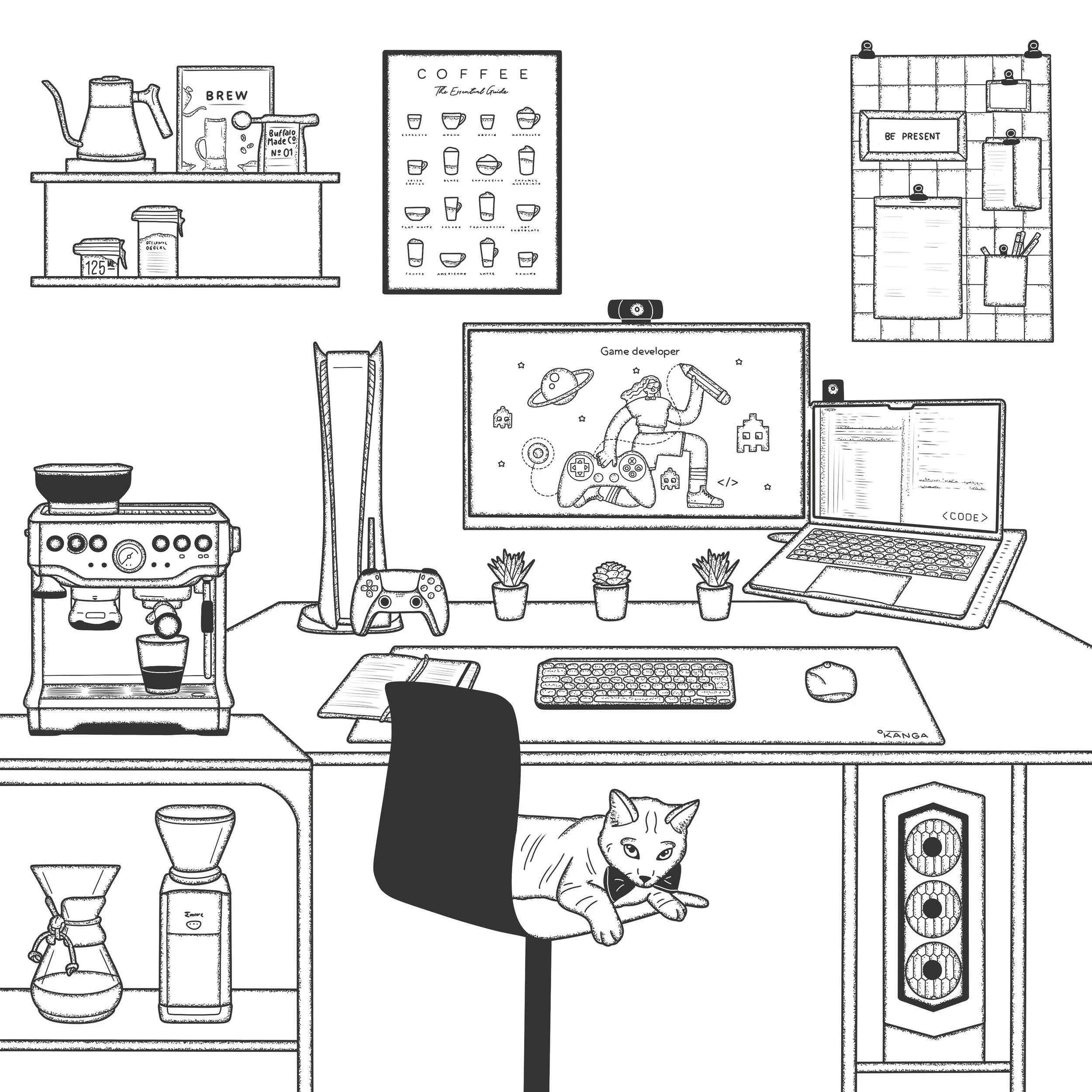
This is what my workspace looks like!
Video game console + controls. I have to test out the work!
My cat. <3
Notebooks & journals. For mapping out ideas and building stories.
Laptop + Monitor. Most of my work is on my computer.
Coffee cart. I have to have my coffee machine, Chemex, & a couple of mugs.

Did you know...There is both an art and a science to game design.
There are over 227 million people in the US who love to play video games, but what goes into making those games? The work of a game developer varies depending on the size of the company they work for and their specialty. At large companies, developers often have specialized roles, focusing on a specific aspect of the game, such as graphics, sound, or coding. However, at indie studios, developers might wear many hats, being involved in multiple parts of the game's creation. Behind a single video game are thousands of lines of code, creative graphic designers, talented writers, business experts, countless meetings, and imaginations working together.
But game design isn’t just about creativity and technical skills—it’s also a science. Developers carefully study what motivates players and how to keep them engaged, relying on research and evidence to fine-tune everything from the difficulty level to the storyline. This balance of art and science is what makes games so captivating. It’s why games can be so immersive and rewarding, keeping players coming back for more.
The principles of game design are so powerful that they’re even being used outside of gaming. This process, called gamification, applies game-like elements to non-game contexts, such as education. By incorporating things like rewards, challenges, and progress tracking, gamification makes learning more engaging and fun. Whether for entertainment, education, or cultural experiences, game design is a field where creativity meets rigorous research, resulting in experiences that can be both enjoyable and meaningful.
Rewarding
These are the parts of my job I find particularly rewarding.

Brainstorming new ideas for entertaining games.
Writing the script, the storyline, and dialogue for a new game.
But everyone is different! Drag the circles to place them where you rate them.Challenging
These are the parts of my job I find particularly challenging.
Staying updated with the latest technology in game design.
Spending a lot of time alone, coming up with ideas and being behind a computer.
Section Styles movable
These are the people I work with:

Programmer
There are thousands of lines of code behind a single video game, there are often multiple computer scientists working on a game with me.

Game Artists
I work with graphic designers to make the visuals of the game come to life. They help create characters, selecting landscapes, color palettes, and the overall visual look and feel of each game.


Players
These people often are the first to play and test the video games and give me the feedback from a users perspective.
WHAT’S NEXT?
What’s next for my field of work?As new technologies emerge, the principles of great game design could shape an incredible next chapter for entertainment.
Extended reality in video games.
As new technologies like extended reality (XR) and artificial intelligence (AI) develop, the principles of great game design are poised to shape the next chapter of entertainment. XR, which includes virtual reality (VR) and augmented reality (AR), is already changing how you experience video games. With a headset, you can immerse yourself in a game world, surrounded by realistic sights and sounds. As XR continues to advance, these experiences will offer even more possibilities for creativity and interaction.
AI is playing an important role in this evolution by helping to create game environments that are smarter and more responsive. If you’re interested in gaming and technology, this is an exciting time to explore the field. The future of entertainment will be influenced by these emerging technologies, and understanding game design principles could be key to shaping the immersive experiences of tomorrow.
Looking for teacher resources?
PHOTOGRAPHER: Ella Sophie • Illustrator: Ana Latese© 2024 THE PLENARY, CO. ALL RIGHTS RESERVED. TERMS. PRIVACY.This is a brand new site! See an issue? Let us know.