

Section Styles spotlight-header
I am an
ORGANIC CHEMIST
Jo Anna Robinson
Presented by the AMGEN Foundation

Chemistry is an essential part of developing medicines.
As an Organic Chemist, I look for enzymes that can help make chemical processes more environmentally-friendly.
MY WORK SETTING


Indoor vs. Outdoor
I spend all of my time working inside the lab or a desk, although I try to take breaks outdoors.

People vs. Alone
I spend a lot of time alone running experiments, and maybe 20% of my day in meetings.


Creative vs. Defined
While there is a lot of creativity involved in organic chemistry, we need to follow some very strict safety measures.

-
In medicine, researchers often need to change one set of chemicals into another, a process known as "chemical transformations". One way to achieve this is through the use of substances like "reagents" and "solvents", which can be harsh and even toxic. Another way is to use enzymes, which are biological proteins that can accomplish the same goal. My job is to examine many enzymes (often hundreds) to find ones that can create the chemical transformations we need.
-
Sometimes our approach may be to find the right enzyme for the job by running lots and lots of experiments to see what different enzymes will do under different conditions. Other times, our goal is to make the right enzyme for the job. We can change the DNA of a promising enzyme, then run experiments to see how the changes we made impact it. Both techniques require a lot of sophisticated lab equipment and technology, and sometimes require me wearing fancy full body protective gear to stay safe.
-
Getting chemical reactions and transformations right is an important part of medical research and drug discovery. Unfortunately, using some substances can be very wasteful, energy-inefficient, and even toxic. That means they're not great for the environment. In my work, we use enzymes instead. Enzymes are biological, so they're a lot more environmentally-friendly and require way less energy. It takes a lot of time to get right, but it's so worth it if it means we can pursue our own health while protecting the planet.
MY WORK NEEDSEssential Skills:
DETERMINATION
Working in drug development takes courage to try new things, understand they may fail, but continue to try anyway.
HUMILITY
You have to admit when you don’t know. Arrogance can be very dangerous in the lab, and can lead to accidents.
PATIENCE
It takes a lot of time to find (or make) the right enzyme for the job. You have to be willing to play the long game.
CURIOSITY
As processes continue to evolve, we must remain open and motivated to learn new ways to do our work.
DAYS IN THE LIFE
Days in the Life
Come along and explore what three days at my job might look like!
How I Work
Check out what my place of work looks like on an average day.

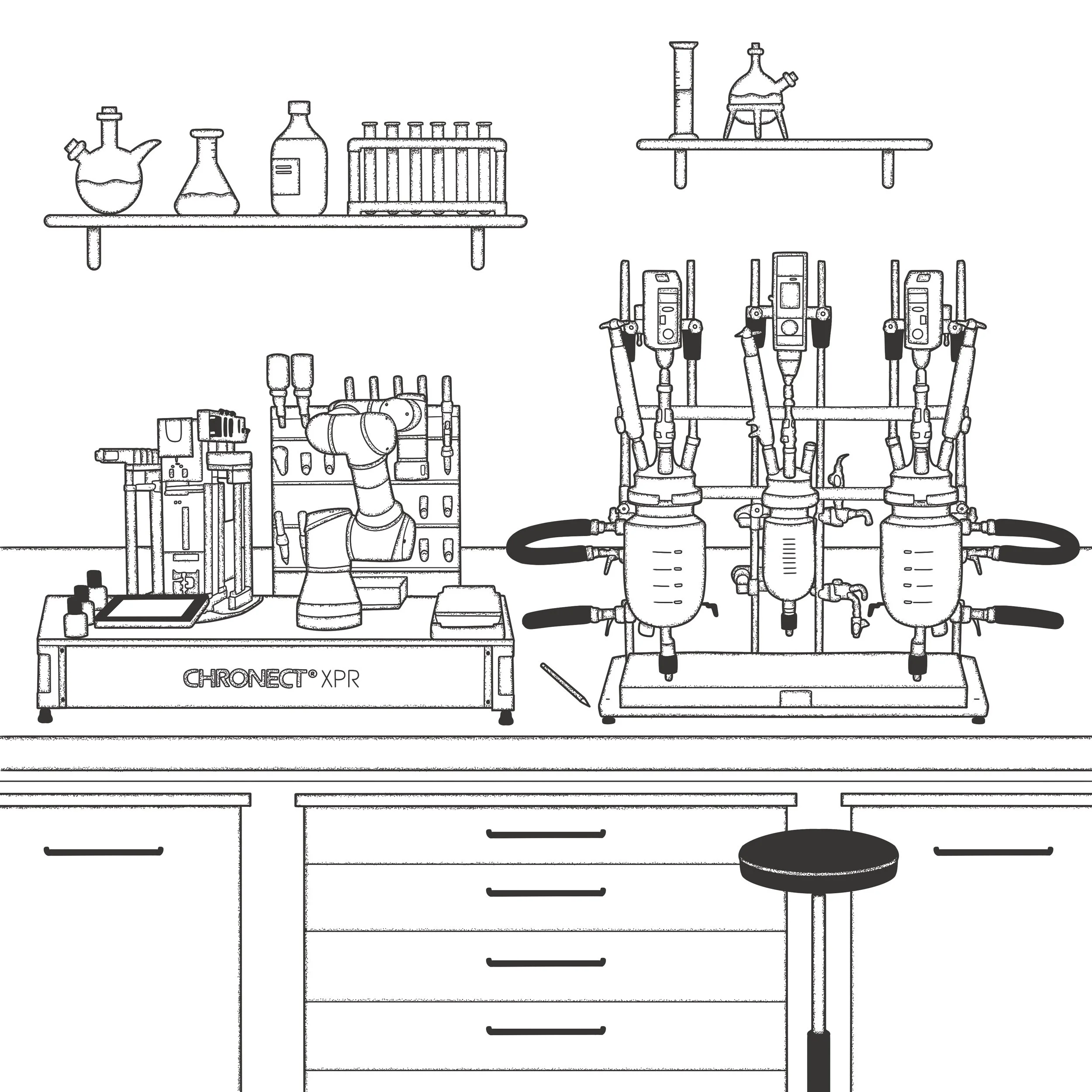
This is what my workspace looks like!
Advanced Equipment. My lab bench has high tech tools that help me run my experiments, catalyze chemical transformations, and develop the formulations I need.
Safety Gear. Even though our work focuses on more eco-friendly solutions, we still have to play if safe!
Fume Hood. This is a piece of safety equipment that ventilates my space to keep the air clean of any toxins.
Lots of Chemicals. Our lab has a lot of different substances and formulations that we work with in our experiments.
Computers (not pictured). A lot of my work involves data analysis and communication, so I spent a lot of time at my desk with my computer too.
Did you know...“Green Chemistry” is an important and growing movement to make the field more sustainable.
Traditionally, chemistry has relied on methods that aren't always the best for our planet. For example, many conventional chemical processes uses toxic reagents, generate harmful byproducts, and consume large amounts of energy. Think of it like using a gas-guzzling car from the 1970s that pollutes the air and burns fuel inefficiently. These old-school methods have left a significant environmental footprint, contributing to pollution, waste, and energy inefficiency. The impact of unsustainable chemistry practices has been widespread. Some biotech and chemical processes have led to environmental damage, such as contaminated water sources, harmful emission, and the accumulation of toxic waste. This is why it’s so crucial to address these issues. By rethinking how we approach chemistry, we can reduce these negative impacts and create a healthier planet. Traditional chemical manufacturing ofter involves hazardous substances that can be dangerous to both the environment and human health. Cleaning up these practices is not just about being eco-friendly; it's about ensuring the long-term safety and sustainability of our world.
The good news is that Green Chemistry is making incredible strides! Over the past couple of decades, researchers have been finding innovative ways to use biological systems instead of toxic chemicals. For example, enzymes from bacteria are now used to clean up oil spills and break down pollutants in water. These biological catalysts are not only effective but also environmentally friendly. Interdisciplinary work is playing a big role in these advances, combining insights from biology, chemistry, and environmental science to develop cleaner, greener solutions. Companies and scientists are working together to create sustainable products, like biodegradable plastics and renewable energy sources, showing that a greener future is not just possible but already happening.
Rewarding
These are the parts of my job I find particularly rewarding.

Going through a lot of trial and error to find the right enzyme fit for a project.
Having success on some projects you work on, but not all of them.
But everyone is different! Drag the circles to place them where you rate them.
Challenging
These are the parts of my job I find particularly challenging.
Needing to develop presentations and present them in front of colleagues.
Being in a room with different experts and not always fully understanding what they are talking about.
Section Styles movable
These are the people I work with:

Engineers
They test out the real-world applications and feasibility of our studies.

Other Chemists
We sometimes work together to complete different parts of the process to get them to link up. We also bounce ideas off each other.


Lawyers
I need to talk with patent and IP lawyers to figure out what I can and cannot present at conferences because of the patent laws involved.
WHAT’S NEXT?
What’s next for my field of work?For a long time, biocatalysis (using enzymes to drive chemical transformations) was limited to existing enzymes, but now we can engineer our own.
Creating New Enzymes.
Thanks to fairly recent innovations, we now have the power to modify DNA. We can make very precise changes to enzymes (although we don’t always know what those changes will do until we experiment with them) in hopes of creating enzymes that are more stable or work better for our goals.
This biotechnology is still fairly new, so we’re just at the beginning of learning what’s possible with it. As we continue to learn more, we could get more fine tuned control over engineering enzymes and other biological components that help us develop medicines in even more exciting, efficient, and eco-friendly ways.

Looking for teacher resources?
PHOTOGRAPHER: Tandem Photo • Illustrator: NEST Design© 2024 THE PLENARY, CO. ALL RIGHTS RESERVED. TERMS. PRIVACY.This is a brand new site! See an issue? Let us know.